5 Ways to Build Modern Learning into Your Sales Culture
Traditional ways of learning are falling short with today’s modern workforce.
As technology and digital-first thinking continues to accelerate changes to how we do business, our approach to learning must also catch up.
This visual, originally created by our learning partner, Allego, highlights the evolution of modern learning by showing us the old way versus the new way.
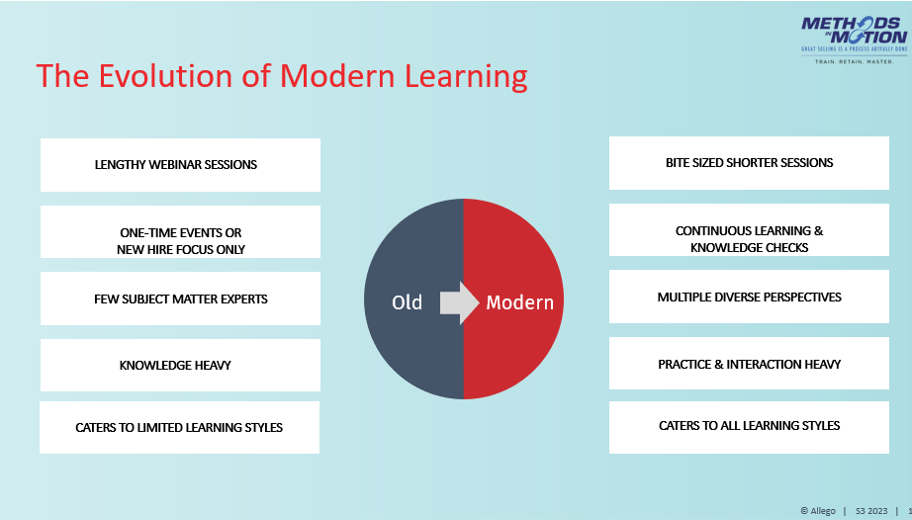
The “old” way still works; however, it must be combined with new and modern approaches to learning in order to build resilience, create muscle memory, and ensure new skills/knowledge won’t be forgotten.
Before we dive into how to build modern learning into your sales culture, let’s take a quick look at what it means:
“A modern learning environment, unlike the traditional one, is a learning space that is more interactive, innovative, and connected. The primary purpose of a modern learning environment is to help people learn better and nurture their ability to meet future challenges.” (Source)
Modern learning isn’t necessarily about using the latest technology, software, or systems out there, it’s about investing in curiosity, agility, and ongoing education for your sales team.
Prioritizing learning will help your sales team become more productive, innovative, and successful in the long run.
If you’re approach to learning needs an upgrade, here are 5 ways to get started:
1) Create a Library of Content from Your Specialists and Subject Matter Experts
Rather than a few subject matter experts, ensure you are leveraging multiple diverse perspectives.
You likely already utilize Subject Matter Experts and Specialists in your onboarding approach. Make the most of what you’re already doing by capturing 3-5 minute recordings across a mix of experts, especially if training is being delivered virtually. It’s as easy as hitting ‘record’ and then editing to highlight those “golden nuggets” during the session.
Soon you’ll have a library of content from your experts to play for new hires throughout their first 1-2 years rather than only learning from these experts in live sessions during the onboarding process.
2) Make learning continuous and bite-sized.
Spread learning over time and break it up into small chunks wherever possible. This reduces cognitive load and can actually ease the perceived burden of learning. Studies show that this gives people a sense of empowerment when it comes to learning and thus produces better training outcomes.
People learn more naturally when training is spaced over time. However, this doesn’t mean you should abandon in-person training. It means we need to think differently about how we design the overall sales onboarding program. Build the program in a way that supports the achievement of milestones throughout the process and take every opportunity to break up learning content and space the delivery over time.
3) Make content easy to create, absorb, and access.
Technology has changed what’s possible when it comes to learning.
Mobile devices make it easy to meet reps where they live and work. That means creating content that’s tailored for viewing and accessing on mobile devices. Think bite-sized materials made for smaller screens.
Using video and visuals are also must-haves when it comes to creating modern learning content because the brain processes visuals faster than text, which makes absorbing the information easier.
4) Assess each team member's strengths and weaknesses to deliver personalized learning.
Thanks to technology, organizations are now using systems and software to assess each learner’s strengths and weaknesses and then deliver “just for me” learning to them.
This may sound like a big investment of time and money, but you can actually use low tech solutions too.
For example, you can create a simple survey using a free option like Google Forms or SurveyMonkey to collect information from your team. Once you’ve gathered the information, you can assess each member to identify a unique learning path just for them or group sessions based on trends across your team.
5) Reinforcement is the key to retention.
Research shows that people forget 80% of what they learn within a month of training without a reinforcement component.
Ensure reinforcement is tied to everything; whether it’s a new business endeavor, change initiative, or training program, reinforcement is what makes new information stick.
Some of our favorite ways to reinforce are:
● Fill a fish bowl with index cards to conduct flash drills to help reps practice skills and product knowledge.
● Put reps in the “hot seat” to role play and practice handling objections.
● Create “teach back” opportunities by giving each rep a chance to teach back what they’ve learned after watching or reading a recent training module.
Learning is key to your resilience as a business. If you invest in curiosity, learning, and agility for your workforce, you will be able to bounce back from setbacks, adapt to change, and be more ready for whatever comes next.